
Building care
Facade Cleaning for Villas and Low-Rise Buildings: Methods and Safety
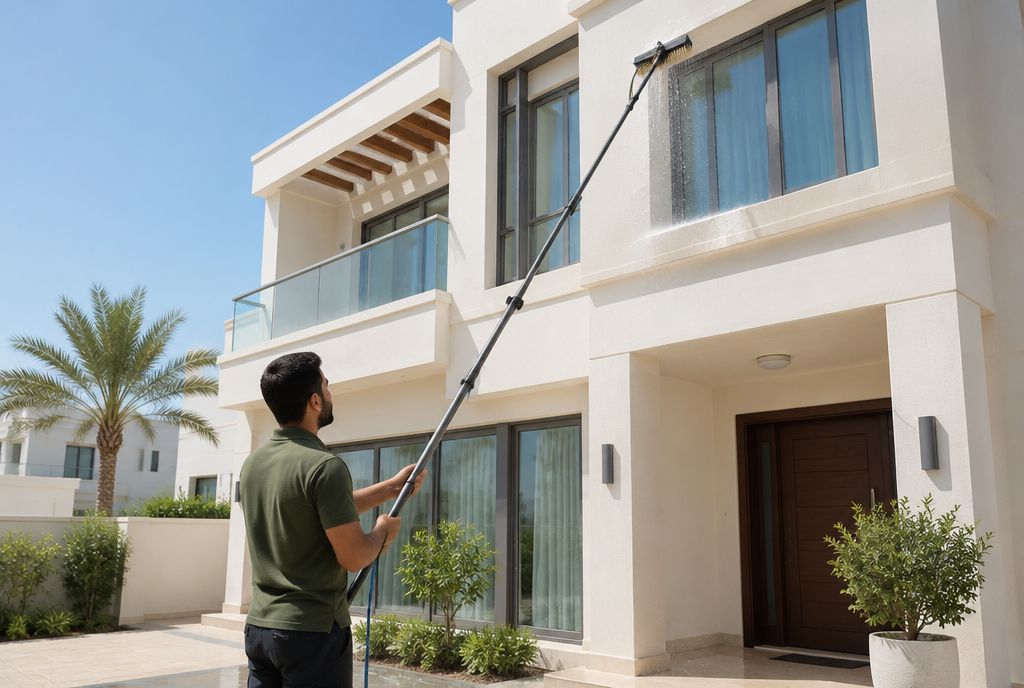
Facade cleaning services remove the dust, sand, staining and grime that build up on the outside walls, glass and cladding of a villa or low-rise building. In Sharjah, where fine dust settles daily and the sun bakes dirt onto surfaces, a regular exterior clean keeps a property looking cared for and helps protect paint, stone and glass. The right method depends on the surface, and because the work happens at height, safety matters as much as the result.
Why facades get dirty in the UAE
Exterior walls take the full force of the local climate. The most common causes of a tired-looking facade are:
- Dust and sand that settle on ledges, window heads and textured paint, then streak down when it rains or when the building is washed
- Humidity, which helps dust stick and can leave a grey film on glass and cladding
- Water staining from AC drips, balcony run-off and sprinklers, often leaving white mineral marks or dark streaks below outlets
- Bird droppings on ledges, signage and window sills
- Algae or dark patches in shaded, damp spots, for example near drain pipes
Common professional facade cleaning methods
There's no single correct technique. Professional teams choose based on the surface, how dirty it is and how it can be reached. In general terms, the methods you'll come across are:
Manual washing
Brushes, applicators and squeegees with a mild cleaning solution, followed by rinsing. It's slower but gentle and controlled, and suits glass, painted surfaces and detailed areas.
Low-pressure washing
Water, sometimes with a suitable detergent, applied at controlled pressure and rinsed off. It's widely used on painted render, tiles and some stone. Pressure has to be matched to the surface: too much can strip paint, force water behind cladding or damage sealant joints.
Higher-pressure or hot-water washing
Sometimes used on hard, durable surfaces such as concrete paving or boundary walls. It's generally not suitable for delicate finishes, older paint or glass seals.
Pure-water glass cleaning
Some teams clean glass using filtered water fed through extendable poles. Because the water has fewer minerals, it can dry with fewer spots. Whether it's used depends on the job and the provider.
Targeted stain treatment
Specific marks such as hard-water stains or algae may need a product suited to that surface. The key word is suited: products that are fine on glass can etch natural stone, and acidic cleaners can damage marble or limestone cladding.
Test first. Any cleaning product or pressure setting should be tested on a small, hidden area of the facade before it's used across the building, especially on natural stone, older paint or coated cladding.
Safety when cleaning at height
Facade work is work at height, and that changes everything. Falls from ladders and balconies are a real risk, and dropped tools or water can injure people below. Whoever does the work, these principles apply:
- Use the right access for the height. Depending on the building, that may mean suitable ladders, mobile towers, extension poles from the ground, or powered access. The choice should be made by someone competent to assess it.
- Trained people only. Anyone working at height should be trained for the equipment they're using.
- Secure the area below. Keep pedestrians, children, pets and cars clear of the work zone.
- Watch the weather. Strong wind, dust storms and the midday heat all make work at height more dangerous. Many teams start early in the day.
- Mind the electrics. Keep water away from outdoor sockets, lighting and AC units, and isolate them where needed.
- Check building rules. For shared buildings and communities, check with building management or the community about access, permits and timing before booking.
As a homeowner, don't try to clean upper-floor walls or windows from a ladder or a balcony railing yourself. Ground-level walls and windows you can reach safely are a reasonable DIY job; anything higher is not.
Villas vs low-rise buildings
For a villa or townhouse, a facade clean usually covers outside walls, window glass and frames, the entrance, boundary walls and sometimes pergolas or shading. It pairs well with a thorough window cleaning and an interior deep clean, especially before selling, renting out or hosting an event.
For a low-rise residential or commercial building, the facade clean is usually arranged by the owner or building management and may need to be scheduled around residents, shop opening hours and parking.
How often to clean a facade
There's no fixed rule. It depends on how exposed the building is, its colour and finish, and how presentable it needs to look. A building next to a busy road, construction site or open sand will need attention more often than one in a sheltered community. Watch for visible streaks under windows, dull glass and staining on light-coloured paint: those are signs it's time.
What affects the cost of facade cleaning services
Facade cleaning is always quoted for the specific building. The main factors are:
- the size and height of the building
- the surfaces involved: paint, stone, glass, cladding or a mix
- how the facade can be accessed safely, and what equipment that needs
- how heavy the staining is, and whether specific treatments are needed
- any timing or access restrictions set by the building or community
Tip Top lists facade cleaning among our services. We confirm the price after a free on-site or photo-based assessment, so you get a clear figure before work starts. If you're arranging other building care at the same time, our guides to water tank cleaning in Sharjah and marble polishing cover what to expect.
Questions to ask a facade cleaning provider
- Which method will you use on each surface, and why?
- How will you reach the higher areas safely?
- How will you protect windows, plants, cars and people below?
- What products will you use, and are they suitable for my stone or paint?
- Do I need permission from building or community management?