
Building care
Marble Floor Polishing Explained: Grinding, Honing and Crystallising
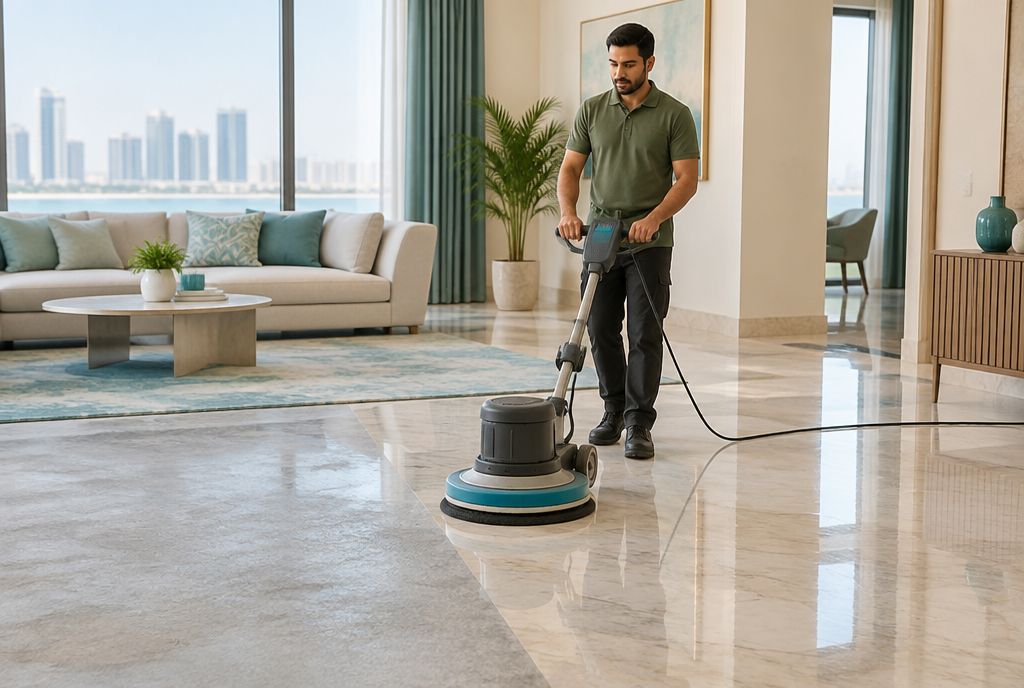
Marble polishing is the process of smoothing the surface of marble with progressively finer abrasives until it reflects light again. Depending on the floor's condition, that can involve up to four distinct stages: grinding, honing, polishing and crystallising. Each one does a different job, and understanding them helps you know what your floor actually needs, and whether polishing will remove the scratches you can see.
Why marble loses its shine
Marble is a natural stone made mostly of calcium carbonate. It's beautiful and durable, but relatively soft compared with porcelain or granite, and it reacts with acids. Its shine comes from a very smooth surface. Anything that roughens that surface makes it look dull:
- Scratches from sand and grit carried in on shoes, which is a constant issue in Sharjah
- Etching from acidic spills and cleaners, which chemically eats into the surface
- Wear in traffic lanes from years of footsteps
- Lippage, where tile edges sit at different heights after installation or settling
Polishing works by removing a very thin layer of stone to reveal a fresh, smooth surface underneath, then refining it until it shines.
The four stages of marble polishing
1. Grinding
Grinding uses coarse diamond abrasives, usually on a heavy rotary machine with water. It removes the most material and is used to flatten lippage, remove deep scratches and wear, and take out old coatings. It's the most intensive stage, the noisiest and the messiest, and many floors don't need it at all. If a floor is ground, it then has to go through honing and polishing to bring back a finish.
2. Honing
Honing uses a sequence of medium to fine abrasives to smooth the surface left by grinding, or to remove light scratches and etch marks on a floor that didn't need grinding. A honed floor has a smooth, matt or satin look. Some people choose to stop here, because a honed finish shows fewer scratches and is less slippery than high gloss.
3. Polishing
Polishing uses very fine abrasives, polishing powders or compounds to refine the surface until it reflects light. This is what gives marble its classic gloss. On a floor that's only lightly dull, polishing may be the main stage needed.
4. Crystallising
Crystallising, sometimes called vitrification, is an optional final step in which a product is applied and buffed into the surface to add gloss and some resistance to wear. Approaches and products vary between providers, and opinions in the industry differ on when it's appropriate. Ask your provider what they use, how it affects future maintenance, and whether it suits your type of marble.
Grinding, honing, polishing and crystallising compared
| Stage | What it fixes | Finish | Needed on every floor? |
|---|---|---|---|
| Grinding | Lippage, deep scratches, heavy wear, old coatings | Rough until honed | No, only when there's real damage |
| Honing | Light to moderate scratches, etch marks, dullness | Matt to satin | Often |
| Polishing | Dullness; brings back gloss | Gloss | For a shiny finish, yes |
| Crystallising | Adds extra gloss and surface resistance | High gloss | No, optional |
Does polishing marble remove scratches?
It depends on how deep they are.
- Fine surface scratches and light dullness usually disappear with honing and polishing.
- Etch marks from acids are surface damage and normally come out with honing and polishing.
- Deeper scratches you can catch with a fingernail usually need grinding first.
- Chips and cracks aren't scratches; they need filling or repair, and polishing alone won't hide them.
- Deep stains that have soaked into the stone, such as oil or rust, may need specific treatment and don't always come out completely.
Quick test: run a fingernail across a scratch. If it glides over, the scratch is shallow and honing should deal with it. If it catches, expect grinding to be part of the job.
Sealing: a separate step
Sealing is often confused with polishing. A penetrating sealer soaks into the stone to slow down how quickly liquids are absorbed, which helps prevent stains. It doesn't make the floor shiny and it doesn't stop etching from acids. Whether your marble needs sealing depends on the stone and where it's used, such as kitchens and bathrooms.
Caring for marble after polishing
- Use a pH-neutral cleaner made for stone.
- Avoid vinegar, lemon and other acids, including many general bathroom and limescale cleaners.
- Dust mop daily to remove sand before it scratches.
- Wipe spills quickly and use doormats at every entrance.
- Put felt pads under furniture legs.
How long the result lasts depends on traffic and care; our guide on how often to polish marble floors covers the timing. Regular deep cleaning with the right products also helps; see our overview of house cleaning services in Sharjah.
Which stages does your floor need?
The honest answer is that it needs someone to look at it. Tip Top offers marble polishing among our services, and the price depends on the area, the floor's condition and which stages are needed. We confirm it after a free on-site or photo-based assessment, before any work starts.