
AC care
Mould in Your AC: Warning Signs and How It's Cleaned
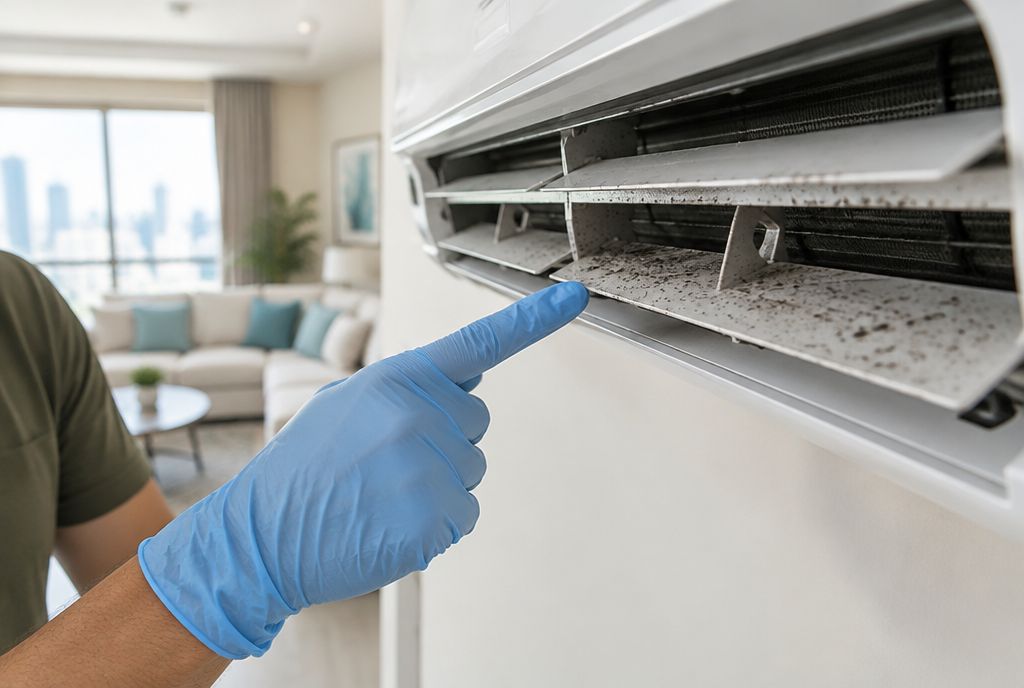
Mould in an AC usually grows where moisture and dust meet: on the cooling coil, in the drain tray, on damp duct linings and around the grilles. Common warning signs are a musty smell when the AC starts, black or dark green spots on or near the vents, and water that isn't draining properly. Light marks on grilles can be wiped, but mould inside the unit or ducts should be cleaned by a professional.
Why mould grows in AC systems
An air conditioner cools air by passing it over a cold coil. Moisture in the air condenses on that coil and drips into a drain tray. In a humid climate like the UAE's, the coil and tray are wet for long periods. Add dust, which mould can feed on, and a dark enclosed space, and you have good conditions for mould to grow.
It's more likely when:
- the drain tray or drain line is partly blocked, so water sits
- the filter is dirty, letting more dust onto the coil
- the AC is switched off for long periods in humid weather, such as during summer travel
- there's a leak or condensation problem around the ducts
- the system hasn't been cleaned for a long time
Warning signs of mould in your AC
A musty or damp smell
The classic sign. It's often strongest in the first few minutes after the AC switches on, when air passes over the damp coil and tray. If you're not sure the smell is mould, our article on why an AC smells covers other common causes.
Visible spots or patches
Black, grey-green or dark brown spots on grilles, on the louvres of a split unit, or on the ceiling around a diffuser. Dust streaks can look similar, so look closely: mould often appears as speckles or fuzzy patches rather than an even grey film.
Water problems
Dripping from the indoor unit, a damp patch on the ceiling below it or a gurgling drain suggest that water isn't draining properly, which encourages mould.
Symptoms indoors
Some people notice a stuffy nose, sneezing, itchy eyes or coughing that feel worse indoors. These symptoms have many possible causes. If you or anyone in your home has symptoms, especially young children, older people or anyone with asthma or a weakened immune system, see a doctor.
What you can safely do yourself
- Switch off the AC before touching the unit or grilles.
- Clean the filter by vacuuming or washing it as the manufacturer recommends, then let it dry fully before refitting.
- Wipe light marks on grilles and louvres you can reach with a damp cloth and a mild household cleaner, wearing gloves.
- Keep the room ventilated where possible, and avoid long periods with the AC off in humid weather.
Leave heavy mould to a professional. Don't try to remove extensive mould from inside the unit, the coil or the ducts yourself. Disturbing it can spread spores into the room, and the unit contains electrics and delicate fins. Never mix cleaning products, and don't spray household chemicals into the AC.
How mould in an AC is professionally cleaned
- Inspection of the unit, coil, drain tray and ducts to find where the mould is and how far it has spread.
- Protecting the room and switching off the system.
- Cleaning the coil with a suitable cleaner and rinsing away loosened growth.
- Clearing the drain tray and line, so water drains freely and doesn't sit.
- Duct cleaning with extraction, where mould or dust is present inside the ducts.
- Grilles removed, washed and refitted.
- Applying an HVAC-suitable sanitiser to the affected parts, with ventilation afterwards.
- Finding the cause. If there's a leak, poor drainage or insulation problem, it needs fixing, or the mould is likely to return.
Our complete AC duct cleaning guide explains the duct side of the process in more detail.
Stopping mould from coming back
- Clean the filter regularly.
- Watch for drips or damp patches and act on them early.
- Book a duct and coil clean at least once a year in the UAE, more often if mould has been a problem.
- Before a long summer trip, ask an AC technician how best to manage humidity while you're away.
- Fix any water leaks in the ceiling around the unit.
What mould treatment adds to the cost
Mould cleaning involves more time and sanitising than a routine clean, so it's one of the factors that affects the price, along with the number of units and vents, property size and access. Our articles on AC duct cleaning costs and AC duct cleaning prices in Sharjah explain the factors. Tip Top confirms the price after a free on-site or photo-based assessment, and uses low-odour, non-toxic products as standard.